Finland History Location: Northern Europe, bordering the Baltic Sea,
Gulf of Bothnia, and Gulf of Finland, between Sweden and
Russia Location: Northern Europe, bordering the Baltic Sea,
Gulf of Bothnia, and Gulf of Finland, between Sweden and
Russia Geographic coordinates: 64 00 N, 26 00 E Map references: Europe Area: total: 337, 030 sq km land: 305, 470 sq km water: 31, 560 sq km Area - comparative: slightly smaller than Montana  Land boundaries: Land boundaries: total: 2, 628 km border countries: Norway 729 km, Sweden 586 km, Russia 1, 313 km Coastline: 1, 126 km (excludes islands and coastal indentations) Maritime claims: contiguous zone: 6 nm continental shelf: 200-m depth or to the depth of exploitation exclusive fishing zone: 12 nm territorial sea: 12 nm (in the Gulf of Finland - 3 nm) Climate: cold temperate; potentially subarctic, but comparatively mild because of moderating influence of the North Atlantic Current, Baltic Sea, and more than 60, 000 lakes Terrain: mostly low, flat to rolling plains interspersed with lakes and low hills Elevation extremes: lowest point: Baltic Sea 0 m highest point: Haltiatunturi 1, 328 m Natural resources: timber, copper, zinc, iron ore, silver Land use: arable land: 8% permanent crops: 0% permanent pastures: 0% forests and woodland: 76% other: 16% (1993 est. ) Irrigated land: 640 sq km (1993 est. ) Natural hazards: NA 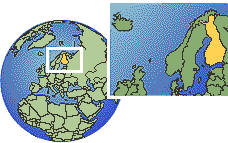 Environment - current issues: air pollution from
manufacturing and power plants contributing to acid
rain; water pollution from industrial wastes,
agricultural chemicals; habitat loss threatens wildlife
populations Environment - current issues: air pollution from
manufacturing and power plants contributing to acid
rain; water pollution from industrial wastes,
agricultural chemicals; habitat loss threatens wildlife
populations Environment - international agreements: party to: Air Pollution, Air Pollution-Nitrogen Oxides, Air Pollution-Sulphur 85, Air Pollution-Sulphur 94, Air Pollution-Volatile Organic Compounds, Antarctic-Environmental Protocol, Antarctic Treaty, Biodiversity, Climate Change, Desertification, Endangered Species, Environmental Modification, Hazardous Wastes, Law of the Sea, Marine Dumping, Marine Life Conservation, Nuclear Test Ban, Ozone Layer Protection, Ship Pollution, Tropical Timber 83, Tropical Timber 94, Wetlands, Whaling signed, but not ratified: Air Pollution-Persistent Organic Pollutants, Climate Change-Kyoto Protocol Geography - note: long boundary with Russia; Helsinki is northernmost national capital on European continent; population concentrated on small southwestern coastal plain Background: Ruled by Sweden from the 12th to the 19th centuries and by Russia from 1809, Finland finally won its independence in 1917. During World War II, it was able to successfully defend its freedom and fend off invasions by the Soviet Union and Germany. In the subsequent half century, the Finns have made a remarkable transformation from a farm/forest economy to a diversified modern industrial economy; per capita income is now on par with Western Europe. As a member of the European Union, Finland was the only Nordic state to join the euro system at its initiation in January 1999. People Population: 5, 167, 486 (July 2000 est. ) Age structure: 0-14 years: 18% (male 478, 497; female 459, 646) 15-64 years: 67% (male 1, 747, 738; female 1, 712, 058) 65 years and over: 15% (male 295, 177; female 474, 370) (2000 est. ) Population growth rate: 0. 17% (2000 est. ) Birth rate: 10. 8 births/1, 000 population (2000 est. ) Death rate: 9. 73 deaths/1, 000 population (2000 est. ) Net migration rate: 0. 58 migrant(s)/1, 000 population (2000 est. ) Sex ratio: at birth: 1. 04 male(s)/female under 15 years: 1. 04 male(s)/female 15-64 years: 1. 02 male(s)/female 65 years and over: 0. 62 male(s)/female total population: 0. 95 male(s)/female (2000 est. ) Infant mortality rate: 3. 82 deaths/1, 000 live births (2000 est. ) Life expectancy at birth: total population: 77. 41 years male: 73. 74 years female: 81. 2 years (2000 est. ) Total fertility rate: 1. 7 children born/woman (2000 est. ) Nationality: noun: Finn(s) adjective: Finnish Ethnic groups: Finn 93%, Swede 6%, Lapp 0. 11%, Roma 0. 12%, Tatar 0. 02% Religions: Evangelical Lutheran 89%, Greek Orthodox 1%, none 9%, other 1% Languages: Finnish 93. 4% (official), Swedish 5. 9% (official), small Lapp- and Russian-speaking minorities Literacy: definition: age 15 and over can read and write total population: 100% (1980 est. ) male: NA% female: NA% Communications Telephones - main lines in use: 476, 078 (yearend 1998) Telephones - mobile cellular: 246, 000 (yearend 1998) Telephone system: foreign investment in the form of joint business ventures greatly improved telephone service; Internet services available throughout most of the country; about 150, 000 unfilled subscriber requests domestic: local - the Ministry of Transport and Communications is expanding cellular telephone services to form rural networks; intercity - highly developed fiber-optic backbone (double loop) system presently serving at least 16 major cities (1998) international: fiber-optic cables to Finland, Sweden, Latvia, and Russia provide worldwide packet switched service; two international switches are located in Tallinn Radio broadcast stations: AM 3 (all AM stations inactive since July 1998), FM 82, shortwave 1 (1998) Radios: 1. 01 million (1997) Television broadcast stations: 31 (plus five repeaters) (September 1995) Televisions: 605, 000 (1997) Internet Service Providers (ISPs): 6 (1999) Railways: total: 1, 018 km common carrier lines only; does not include dedicated industrial lines broad gauge: 1, 018 km 1. 520-m gauge (132 km electrified) (1995) Highways: total: 49, 480 km paved: 10, 935 km (including 75 km of expressways) unpaved: 38, 545 km (1998 est. ) Waterways: 320 km perennially navigable Pipelines: natural gas 420 km (1992) Ports and harbors: Haapsalu, Kunda, Muuga, Paldiski, Parnu, Tallinn Merchant marine: total: 50 ships (1, 000 GRT or over) totaling 306, 264 GRT/293, 083 DWT ships by type: bulk 3, cargo 20, combination bulk 1, container 5, petroleum tanker 2, roll-on/roll-off 13, short-sea passenger 6 (1999 est. ) Airports: 5 (1997 est. ) Airports - with paved runways: total: 5 over 3, 047 m: 1 2, 438 to 3, 047 m: 1 914 to 1, 523 m: 3 (1997 est. ) The publishers of International Education Website regret that they cannot accept any responsibility for the material linked to or contained in these pages. International Education Media make no warranties, either express or implied, about the truth or accuracy of this site or any site linked to it, or from it.
| About
Us |
| ||||||||||||||||||
