Study
Nursing in ThailandChiang Mai University
Thailand -
Faculty of Nursing
BACHELOR OF NURSING SCIENCE - Four Years
Programme
Description
This
programme is designed to deliver professional nurses able to provide
nursing care both in hospital and community settings. At the end of the
programme students are awarded their degree and their license to practise
as registered nurses and midwives.
Programme
Objectives
Graduates
will be able to:
-
apply their knowledge of
nursing and primary health care to health promotion, disease
prevention, nursing care and rehabilitation in hospital and community
settings;
-
provide nursing care for
individuals, families and communities; -
teach, advise and give
consultation to clients and to the public, placing emphasis on self
care to achieve good health;
-
adopt professional nursing
practises and apply professional ethics;
-
build and maintain good
working relationships with colleagues and work with health care
professionals of all disciplines;
-
be a nursing team leader,
think creatively, critically and analytically, and be able to make
sound decisions.
Admission
Procedure
In
order to be considered for admission, applicants should:
-
have completed 12 years of
schooling;
-
be in good general health.
Selection
is made on the basis of performance in the written entrance examination
(either a quota entrance examination arranged by Chiang Mai University for
the graduates of high schools in the 17 northern provinces or an entrance
examination arranged by the Ministry of University Affairs) and a personal
interview.
Course
Requirements
Students
must obtain a total 149 credits. Thirty-three credits from general basic
courses, 110 credits from major courses and six credits from elective
courses.
Degree
Requirements
To
obtain a degree students must attain a grade average of at least 2.0 in
major courses and a total grade point average of at least 2.0.
BACHELOR OF NURSING SCIENCE - Two Years
This
programme is designed to enable nurses educated from Associate Diploma
level to continue their education to Bachelor Degree level.
Programme
Objectives
Graduate
students will be able to:
-
apply their knowledge of
nursing and primary health care to health promotion, disease
prevention, nursing care and rehabilitation in hospital and community
settings;
-
provide nursing and give
consultation to clients and the public, placing emphasis on self care
to achieve good health;
-
adopt professional nursing
practices and apply professional ethics;
-
build and maintain good
working relationships with colleagues, and work with health care
professionals of all disciplines;
-
be nursing team leaders, think
creatively and analytically, and be able to made sound decisions.
Admission
Procedure
Nursing
holding an Associate Diploma in Nursing may take the examination.
Selection is made on the basis of performance in the examination and an
interview with the Faculty.
Course
Requirements
Students
are required to obtain a total of 149 credits. Sixty-nine credits are
granted on admission based on the attainment of the Associate Diploma in
Nursing and Midwifery or its equivalent. A further 80 credits are required
as follows: 21 from general basic courses, 53 from major courses and six
from elective courses.
Degree
Requirements
To
obtain a degree students must attain a grade point average of at least
2.0.
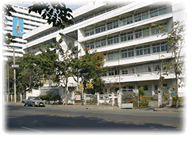
History
The
institution now known as the Faculty of Nursing was established in 1959 as
a Division within the Faculty of Medicine at Siriraj Hospital, in Bangkok,
for the purpose of moving to the north. In 1960 the Faculty of Medicine,
including the Nursing Division, moved to Chiang Mai, becoming the first
Medical School under the Ministry of University Affairs to be set up
outside the capital. Its aim was to provide better medical care and
education for the people in the north and to introduce preventative
measures in public health for rural people.
In 1965 the Faculty of Medicine was incorporated into Chiang Mai
University, and in 1972 the Faculty of Nursing became a separate faculty
within the University.
Philosophy
We
believe that nursing is an essential profession in society which
contributes to the health and well being of entire nations. As the
profession develops, nurses are taking on an increasing responsibility for
providing health care services, and we want to ensure nurses are prepared
to meet these challenges. It is our aim to highlight nursing as a
profession which serves not only individuals and families but whole
communities.
Nurses care for people who are ill, people who are at risk of ill-health,
and people who are healthy. We want nursing services to provide health
promotion, primary health care, disease prevention, nursing care and
rehabilitation. We also want nurses to help empower individuals to manage
their own health care.
We are renowned for providing many of the most professional and highly
qualified nursing experts in the country.
Function
As
a commitment of Chiang Mai University, we have four principal functions:
education, research, community service and cultural conservation.
Education
This
is our faculty's primary function. Our skilled academic staff is able to
provide vital programmes and courses, designed specifically to meet the
increasing needs of society. These programmes range from certified through
to specialised post graduate programmes and international short training
courses. The Faculty of Nursing has 162 full time teaching staff (37
associate professors, 37 assistant professors and 88 teaching
instructors).
Candidates
from all over Thailand are choosing to study at our faculty in Chiang Mai
University and we are also developing programmes to assist neighbouring
countries. Our reputation enables us to select the very best academic
staff and the most promising student candidates for our programmes.
We
have adopted an interdisciplinary approach and flexible, student centred
programmes. All students are expected to become proficient in self
directed study.
The
undergraduate programmes have both practical and theoretical elements to
ensure students become fully prepared for their important care role. They
gain practical experience in the specialist laboratories on campus before
practising in the various hospitals, clinics, workplaces and homes.
Our
postgraduate courses focus on the student's chosen area of specialisation,
and contain a greater emphasis on academic rigour and independent
research.
Exceptional
students on the Bachelor Degree programme have the opportunity to compete
for places on international student exchange visits to overseas
universities. Students visiting the Faculty of Nursing from universities
abroad are in both undergraduate and graduate programmes, and courses are
designed by the Faculty of Nursing in accordance with objectives of the
students.
We
are constantly planning and developing international programmes. Nurses
from Asia, Africa, the Middle East and the Pacific attend our
international short courses. These courses are designed to promote an
international exchange of knowledge and experience and to provide students
with an opportunity to gain theoretical knowledge and clinical experience.
Research
Research
work is currently undertaken by the Research Promotion Committee which
promotes research among faculty members and students and helps them
develop their research skills. It offers workshops, seminars and
presentations by scholars from Thailand and overseas.
Research
is funded through a variety of agencies which include the Royal Thai
Government, the National Research Council, Chiang Mai University, the
China Medical Board of New York, Inc., the World Health Organization,
UNFPA, UNDP and others. Funding is allocated by the Research Promotion
Committee.
Our
aim is to deepen and broaden knowledge in nursing through research. By the
end of 2001, 265 research projects had been completed and others are
currently in progress. These projects included HIV/AIDS research and the
relatively new areas of gerontological nursing practice, clinical nursing,
nursing administration, and nursing education. Each of the eight nursing
departments in the Faculty of Nursing has research work in progress. In
the year 2001 the Faculty of Nursing established a Center for Nursing
Research accessible to all nursing personnel in the north of Thailand.
Community Services
We
provide a service to transfer knowledge to the community, to improve the
health of local people and to develop the nursing profession. We currently
offer services such as the Rural Health Care Programme, the Childbirth
Preparation Programme, the Nutritional Programme, the Elderly Health
Promotion Programme, a Day Care Center for children, and an Elderly Club.
The
Faculty is also responsible for a Royal Project and a King's Project which
provide services to rural people of the North. Theses project focus on
health improvement for people in rural or remote areas.
We
provide in-service training for professional nurses, especially those in
the north of Thailand. To date, this training has included orthopaedic and
rehabilitation nursing, infection control nursing, critical care,
gerontological nursing and management of HIV/AIDS training.
Health
education training for community leaders, Buddhist monks, school teachers,
students and local people is also provided. Topics include first aid, self
medication and self care, prevention of drug abuse, family planning, child
health and child care.
Cultural Conservation
Cultural
conservation is also encouraged. Our faculty and students participate in
activities aimed at conserving and promoting Thai and Lanna culture and
tradition. We actively support local and University community ceremonies,
and encourage student's participation.
Faculty
Structure
The
Faculty of Nursing has been headed by Dean Wipada Kunaviktikul, R.N.,
D.S.N. since May 2001. She is assisted by seven Associate Deans, two
Assistant Deans, and there are eight department heads within our faculty.
There
are 162 full time faculty members and 136 support staff personnel. (See
page 55 for a full list of faculty members.)
We
also have an active International Relations Office which provides
seminars, workshops and presentations conducted by Thai and overseas
specialists.
Students
There
are approximately 1,000 students enrolled in the following programmes:
Certificate
of Practical Nursing (one year programme) 60 per year
Bachelor of Nursing Science (four year programme) 100-150 per year
(two year programme) 50-75 per year
Master of Nursing Science (two year programme) 180 per year
Master of Public Health Nursing (one year programme) 10 per year
Doctor of Nursing Science (three year programme) 13-15 per year
In
addition approximately 70 participants take part in our short
international programmes each year.
Location
& Service
We
are located at the southeastern corner of the Health Sciences campus,
immediately to the west of the Suan Dok city gate.
Library
Our
specialist library has a collection of material relevant to Nursing
Science and many research papers and theses.
Computer
Service Center
The
Faculty has a Computer Service Center available for students and faculty
members, which offers word-processing and on-line facilities, research
programs, and training to ensure up-to-date competence in all
computer-based applications. The Center is responsible for maintaining the
computers throughout the faculty, and is connected to the main University
network for research and communications.
Learning
Resource Centre
This
centre has audio-visual equipment, computer faculties and nursing
laboratories, where students gain nursing skills before undertaking
practical work in clinical settings.
Housing
Priority
is given to undergraduates taking the Bachelor of Nursing Science
programme. All students lodging on campus pay a dormitory fee. In their
first year they share dormitory accommodation on the main campus. During
the next three years they live in Faculty of Nursing dormitories on the
Health Sciences campus. If space is available it is offered to graduate
students. Alternatively there is a wealth of private accommodation
available in Chiang Mai city.
Shopping
and Recreation
A
range of services is available to students including a cafeteria,
hairdresser, dressmaker, and a laundry service. There are several places
to buy food including fresh produce, and a large monthly market is held on
campus. Other facilities such as banks, a post office, markets and shops
are all located on the campus. Dormitories also have typing and photocopy
services for students' academic work.
All
of the recreational facilities on the main campus, situated only one
kilometer away, are available to our students.
The
International Relations Office
Office
of the Dean
Faculty
of Nursing
Chiang
Mai University
110
Inthawaroros Road
Sriphum
District
Amphur
Muang
Chiang
Mai
Thailand
50200
Tel
+66 53 945011, 945012
Fax
+66 53 217145
dean@mail.nurse.cmu.ac.th
www.nurse.cmu.ac.th |
|

The
International Relations Office
Office
of the Dean
Faculty
of Nursing
Chiang
Mai University
110
Inthawaroros Road
Sriphum
District
Amphur
Muang
Chiang
Mai
Thailand
50200
Tel
+66 53 945011, 945012
Fax
+66 53 217145
dean@mail.nurse.cmu.ac.th
www.nurse.cmu.ac.th
|
